You can charge the leisure battery while driving or connect the van to an external power supply. To do this, you need to connect the supplied cable (20 metres long) from the socket on the driver’s side of the camper to a power supply. The vehicle indicates that the battery is charging by switching on an indicator light on the camper unit. The 230V sockets should now work.
To charge the Camper Cabin (Ford Nugget), proceed as follows:
- Open the cover of the Camper Cabin socket (on the driver’s side at the rear).
- Open the cover of the connection cable by 90 degrees and insert the coupling with the cover into the main socket until it clicks into place:
- To disconnect, press the blue lever on the left side of the socket down and pull the plug out at the same time:
There is a small difference between the Camper Cabin models, so check which one you are driving and then select the correct instructions from the dropdown menus:
Activate the control panel by touching the screen.
On the home screen, a bar will be displayed showing the charge level of your leisure battery. Tap the battery bar for more information:
The following menu will show more detailed information about the battery status:
You know the leisure battery is charging correctly when you see a small plug icon next to the battery bar.
Activate the control panel by pressing the ON/OFF button.
On the home screen, a bar will appear showing the charge level of your leisure battery. Tap the battery icon at the bottom for more information:
The following menu will show more detailed information about the battery status:
You know the leisure battery is charging correctly when you see a small battery icon with a glowing dot above the battery bar.
Activate the control panel by pressing the black round button.
On the home screen, a bar and a voltage display will appear, showing how full your leisure battery is: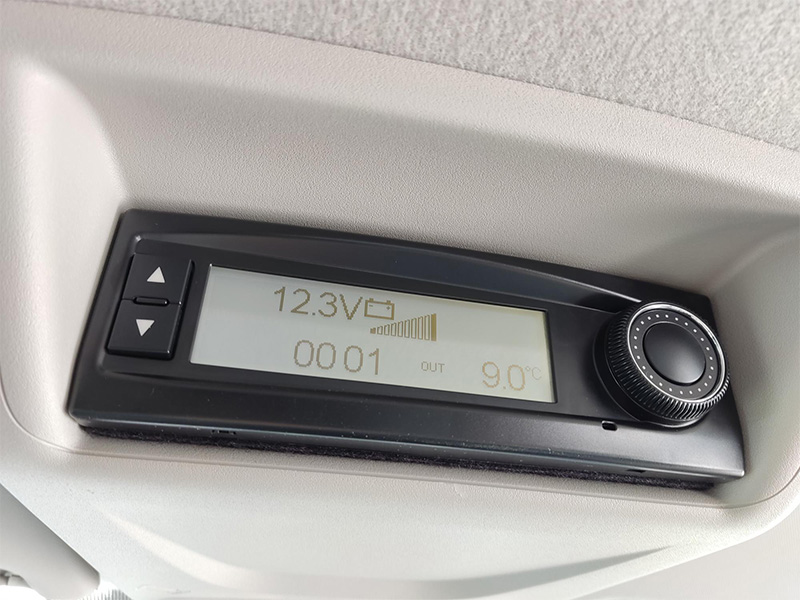
The bar moves up and down when the vehicle is plugged in and charging; the voltage number also changes during charging:
You know the leisure battery is charging correctly when you see a small plug icon on the control panel.
Note:
- Don’t forget to unplug the power cable before driving off! To do this, press the blue lever to the left of the socket down.
- With a fully charged battery, you can be self-sufficient for about 2 days without a power supply. Then you need to drive for a while to recharge the battery or connect your camper to an external power supply.
- Campers cannot be charged at electric vehicle charging stations.
Troubleshooting
(this option does not apply to models with the drawer fridge)
Check that the main switch (large red button) and the RCD switch are both in the correct position. The main switch should be green at the top and the RCD switch should be pointing upwards.
They are located under the kitchen unit. For better access, you can fold the rear seat into a bed position:
If you have problems with the power, switch off the main switch, wait a moment and then switch it on again (green appears above the switch).
Please note the following:
- When stationary, do not charge any device in the driver's cab via USB. The starter battery will discharge and the engine may not start!
- 230V sockets: only work with an external power connection
- USB ports and 12V sockets: work without an external power connection, with a charged camping battery (always keep it above 50% or 12V).
- With a full battery, you can be self-sufficient for 1-2 days without a power connection, depending on usage. Then you need to drive for a while to recharge the battery or connect your camper to an external power source.
- 🚗 Slow driving & short distances → hardly any battery charge
- 🛣️ Long drives on motorways → better charge, but takes several hours
- 🔋 The starter battery is charged first, then the camping battery.
- ⚠️ Driving alone is often not enough to fully charge the camping battery.
- 🔌 Recommendation: charge externally every 48 hours to avoid energy shortages (especially at night 💤).
- Don't forget to unplug the power cable before driving off! For some models, you need to press the blue lever next to the plug downwards.
For deeply discharged camping batteries
As camping batteries are not lithium batteries, we advise you never to discharge them below 30%. This can damage the battery. If you suspect that the camping battery is deeply discharged, try the following:
- Connect shore power and run the engine.
- Try this for about 30 minutes. The extra amperage can bring a deeply discharged battery back up to speed.